


📝 Introduction – When Bridges Collapse, It’s Not Just Steel That Breaks, But Lives
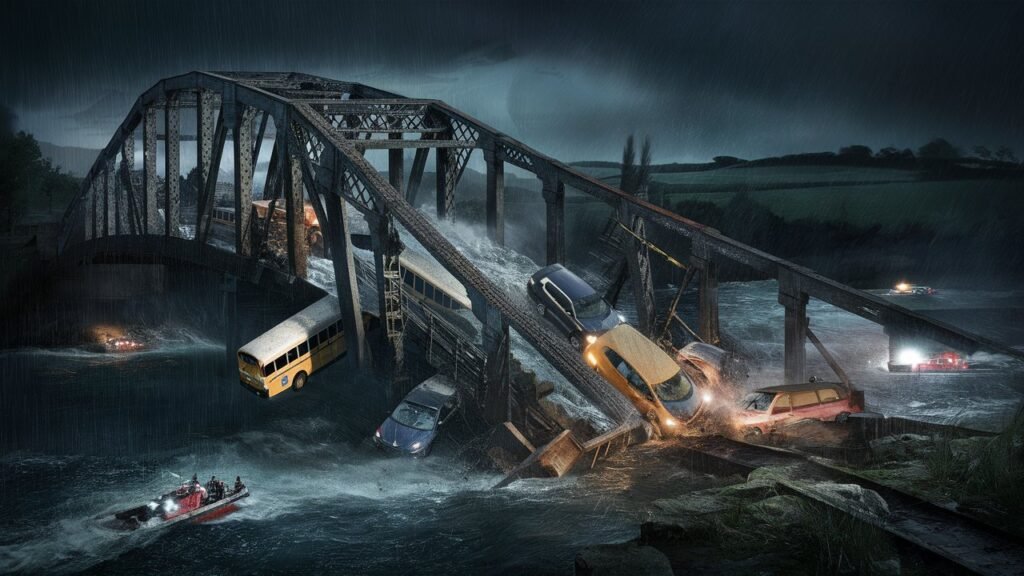
On the night of March 4, 2001, the peaceful Portuguese towns of Entre-os-Rios and Castelo de Paiva were about to witness one of the most devastating infrastructural tragedies in modern European history. The Hintze Ribeiro Bridge, standing tall for over 116 years, suddenly collapsed into the Douro River, pulling 59 lives into the cold depths of water and history.
But this wasn’t just an accident. It was a chilling combination of neglect, corrosion, ignorance, and bureaucratic failure — a perfect storm waiting to consume innocent lives.
🏗️ Chapter 1: The Bridge – Legacy of a Bygone Century
The Hintze Ribeiro Bridge was inaugurated in 1886, serving as a vital transport link between the towns of Entre-os-Rios and Castelo de Paiva in Northern Portugal. Built during a time when engineering was driven by ambition and iron, this bridge was once a symbol of connection and progress.
Key Features:
- Type: Metallic truss bridge
- Material: Steel and iron
- Length: Approximately 160 meters
- Number of sections: 6 trusses
- Function: Carried two lanes of vehicle traffic and pedestrians
Despite its historical significance, the bridge was never adequately modernized. Decades of use, environmental impact, and lack of maintenance had weakened its foundation—literally and figuratively.
🌌 Chapter 2: The Tragic Night – March 4, 2001
At 9:15 PM, on a regular Sunday night, a minibus carrying schoolchildren and two private cars were crossing the Hintze Ribeiro Bridge. As they reached the central span, a deafening sound echoed through the night — the bridge snapped in half and plunged into the river.
In just seconds:
- A major section of the bridge collapsed.
- The minibus and cars fell approximately 30 meters down into the river.
- None of the 59 occupants survived.
Survivors on the riverbank could only watch helplessly as the vehicles sank beneath the dark, icy waters of the Douro River.
“We heard a loud crack and then nothing… just the sound of rushing water,” recalled a local resident.
🚨 Chapter 3: Rescue Operations – A Race Against Time
Immediately after the collapse, rescue teams, divers, and the Portuguese navy were deployed. But the fast-moving river, its strong undercurrents, and the sheer depth made recovery incredibly difficult.
Rescue Highlights:
- Helicopters were dispatched to search the area.
- Navy divers spent weeks retrieving bodies.
- Dozens of corpses were never recovered, their families left without closure.
While the emergency response was rapid, the depth of the river and freezing water made survival impossible.
🏚️ Chapter 4: Decay and Neglect – The Warnings They Ignored
After the disaster, investigations revealed something even more horrifying — this tragedy could have been prevented.
Structural Issues:
- The bridge had significant corrosion.
- Scouring (erosion of sediment) around the foundations had made it unstable.
- No major structural inspection had been conducted in decades.
Human Error:
- Locals had warned authorities multiple times about strange sounds and bridge instability.
- Reports from as early as 1999 highlighted the urgent need for maintenance.
Natural Factors:
- Sand dredging nearby had eroded the riverbed supporting the bridge’s pillars.
- Recent heavy rainfall had further compromised structural integrity.
The collapse wasn’t just nature’s fury. It was systemic failure.
😡 Chapter 5: Public Outrage – When Silence Turned to Screams
The country was shocked. Portugal mourned, but it also got angry.
Reactions:
- Mass protests erupted in several towns.
- National and international media condemned the Portuguese government’s negligence.
- Opposition parties called it an act of “political manslaughter.”
Families of the victims sued the government, demanding accountability and compensation. The bridge collapse had become a symbol of bureaucratic indifference.
🧾 Chapter 6: The Investigation – Blame, Shame, and Little Justice
The Portuguese government set up a commission to investigate the disaster.
Findings:
- The Ministry of Public Works, local municipality, and river authorities were all deemed negligent.
- Engineers ignored past warnings.
- Sand dredging companies operated with minimal regulation.
Outcome:
- A few mid-level officials were suspended.
- No senior minister was held accountable.
- Most accused escaped legal consequences.
The lack of justice further inflamed public anger.
🏗️ Chapter 7: Rebuilding Hope – A New Bridge, A New Beginning
A year later, construction began on a new bridge to restore the crucial transport link.
The New Bridge:
- Opened in 2003.
- Built with modern reinforced concrete.
- Includes smart sensors to detect stress or damage.
- A memorial plaque honors the lives lost in the 2001 collapse.
Yet for many, the new bridge could never replace what was lost.
🌍 Chapter 8: A Global Warning – Lessons the World Must Learn
The Hintze Ribeiro disaster was a wake-up call — not just for Portugal, but for the entire world.
Global Infrastructure Takeaways:
- Routine inspections of aging structures are crucial.
- Scour protection around bridge foundations must be implemented.
- Sand dredging should be scientifically monitored.
- Public warnings must not be ignored.
Following the collapse, multiple countries audited old bridges, revealing thousands of at-risk structures.
🕯️ Chapter 9: The Human Cost – Names Lost in the River
Among the 59 victims were:
- Schoolchildren returning from a field trip.
- Teachers, parents, drivers, and local residents.
- Entire families wiped out in seconds.
A monument near the new bridge now lists their names — not just as a tribute, but as a reminder of what happens when negligence becomes normalized.
🔚 Conclusion – A Collapse That Echoes Still
The Hintze Ribeiro Bridge Collapse is not just a chapter in engineering failure. It is a story of people silenced by bureaucracy, a lesson for modern governance, and a memorial to the power of public accountability.
“Bridges are supposed to connect — but this one severed the bond between trust and government.”
Even today, as vehicles move smoothly over the new structure, locals glance into the river — and many say they can still hear the cries, trapped under the water.
- BBC News – Hintze Ribeiro Bridge Collapse (2001 Coverage)
- The Portugal News – Remembering the Hintze Ribeiro Bridge Tragedy
- Structurae – Engineering Data on Hintze Ribeiro Bridge
- Wikipedia – Hintze Ribeiro Bridge Collapse
- Civil Engineering Forum – Technical Analysis of the Collapse